Felicita Decor
Global buyers choosing Christmas ornaments must balance appearance, durability, shipping risk, and repeat-order consistency. The National Retail Federation’s 2024 holiday forecast projected U.S. November–December retail sales of $979.5 billion to $989 billion. That figure covers many product categories, not ornaments alone, but it signals the scale and seasonal pressure of holiday purchasing. For importers and retailers, a cracked carton can mean more than damaged stock: it can disrupt shelf presentation and customer trust.
Why should I buy shatterproof Christmas balls? Their plastic construction can reduce breakage compared with traditional glass, especially during packing, transport, and busy store handling. Yet “shatterproof” is not a guarantee of indestructibility. Material type, wall thickness, finish quality, and packaging all matter. Ask suppliers for clear specifications, sample products, and drop-test details, rather than relying on a label or a glossy catalog image.
Details matter. A ball that looks bright under showroom lights may arrive with scratches, uneven color, or a loose cap. Check size tolerance, hanging-loop strength, carton protection, and how colors match across production batches. Request photos of packed cartons, not only styled displays. A useful first step.
This guide explains how global buyers can compare materials, finishes, suppliers, and shipping protections before placing an order. It also recognizes a practical limitation: publicly available market reports rarely isolate shatterproof Christmas balls as a standalone category. Buyers should therefore combine broader retail data with supplier verification and hands-on sample checks. One sample cannot prove an entire shipment will be consistent—but skipping samples is a bigger gamble.
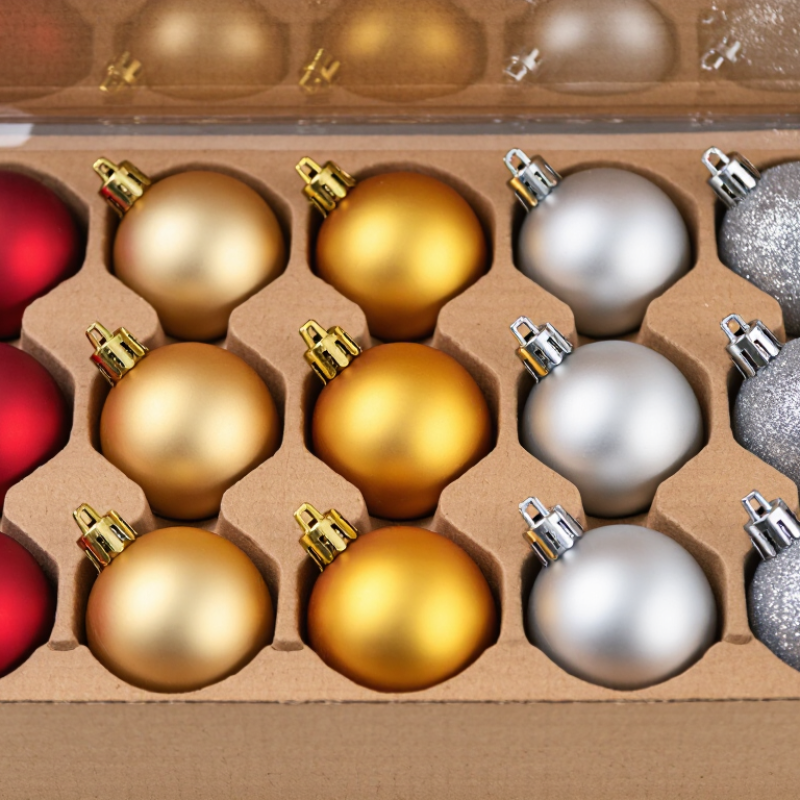
Shatterproof Christmas balls are seasonal ornaments designed to resist cracking and breaking during handling, shipping, and display. They are not completely unbreakable. That distinction matters. A hard impact, sharp edge, or extreme temperature can still damage them. Compared with glass ornaments, these balls usually offer safer handling for homes, retail stores, hotels, and public displays.
They are not completely unbreakable. That distinction matters. A hard impact, sharp edge, or extreme temperature can still damage them.
Material choice affects durability, appearance, and cost. PVC is flexible and suitable for lightweight decorations, but thin walls may crease easily. PET and PETG can provide clear surfaces and useful impact resistance. Polycarbonate is tougher, although it often costs more. Acrylic offers strong transparency and a polished look, yet it may crack under severe impact. Many products use injection molding, while others use blow molding. The molding method influences wall thickness and seam quality.
Look closely at the surface. A glossy finish can hide weak areas. Check the cap attachment, hanging loop, color consistency, and wall thickness. Request production samples before placing a large order. Drop testing, temperature testing, and packaging checks can reveal practical risks. Supplier test records are helpful, but independent inspection gives stronger evidence. Requirements also vary between markets, especially for materials, labeling, and fire performance. Do not assume one document covers every destination. A cheaper ball may pass a visual check and still fail during transport. That possibility deserves honest review.
Choosing shatterproof Christmas balls for global buyers requires more than checking a product label. “Shatterproof” usually means impact-resistant plastic, not unbreakable material. Ask for the exact polymer type, test method, and batch number. A reliable supplier should provide reports from an accredited laboratory, with results linked to the same product specification.
Safety requirements differ by destination. In the European Union, review REACH restrictions, chemical content, labeling, and general product safety duties. If the decoration is marketed as a children’s toy, relevant toy-safety testing may also apply. In the United States, check applicable CPSIA limits for lead and phthalates. ASTM F963 may matter when the product is intended for play. Other markets can require local labeling, importer details, or chemical declarations. Do not treat one certificate as global approval.
Tips: Request recent reports, not screenshots. Confirm tests cover colorants, coatings, sharp edges, small detachable parts, and breakage after impact. Examine packaging for crushed corners and missing warnings during a trial shipment. I have found that sample inspections reveal defects paperwork misses. That is uncomfortable, but useful. Keep product photos, material declarations, and inspection records for every shipment. Requirements can change, and a report from last season may no longer answer today’s question.
| Market | Main regulatory framework | How shatter resistance is assessed | Material and chemical checks | Labeling and documentation priorities | Buyer verification checklist |
|---|---|---|---|---|---|
| European Union | General Product Safety Regulation (EU) 2023/988, applicable from 13 December 2024. REACH restrictions may apply to substances in articles. | No single EU-wide “shatterproof bauble” test is prescribed. Use a documented risk assessment covering impact, breakage, fragments, sharp edges, suspension strength, and foreseeable child access. | Identify the polymer or coating system. Screen relevant restricted substances under REACH; check pigments, coatings, plasticizers, and accessible metal parts. | Product identification, responsible economic operator information, warnings where needed, traceability details, and technical documentation supporting the safety assessment. | Request impact-test records, material declarations, REACH-related laboratory results, batch traceability, and photographs of warnings and packaging. |
| United Kingdom | General Product Safety Regulations 2005, together with applicable UK chemical restrictions and market-surveillance requirements. | Assess whether the decoration can break into hazardous pieces during normal use, foreseeable drops, or handling. A documented product risk assessment is essential. | Verify the declared plastic type and screen coatings, dyes, plasticizers, and metal fittings against applicable UK chemical restrictions. | Include producer or importer details, product identification, safety warnings, and records demonstrating conformity with the applicable safety requirements. | Confirm the same production specification is used for tested samples and shipped goods; retain test reports, supplier declarations, and batch records. |
| United States | Consumer Product Safety Act and Consumer Product Safety Improvement Act may apply. 16 CFR Part 1500 covers hazardous substances and mechanical hazards; ASTM F963 applies when the product is marketed as a toy. | For ordinary decorative use, evaluate breakage, accessible sharp points or edges, detachable parts, and hanging strength. If marketed for play, toy requirements and applicable testing become relevant. | Lead limits and other children’s-product requirements may apply when the item is a children’s product. Check accessible coatings, substrates, and small components through an accredited laboratory. | Provide permanent product identification where required, importer or manufacturer information, applicable warnings, and a General Certificate of Conformity when legally required. | Define the intended-use category, confirm whether children are a reasonably foreseeable user group, and obtain test reports matched to the final material, color, and coating. |
| Canada | Canada Consumer Product Safety Act, including the Consumer Chemicals and Containers Regulations where applicable. Toys may also be subject to the Canada Consumer Product Safety Act toy requirements. | Review foreseeable-use hazards such as cracking, fragmentation, sharp edges, loose caps, and failure of hooks or strings. Toy classification can trigger additional mechanical testing. | Test accessible coatings, plastic components, and metal fittings for restricted substances relevant to the product category and intended users. | Use clear safety information in English and French where required for the Canadian market, together with traceability and importer details. | Verify bilingual packaging, intended-use wording, material declarations, chemical test results, and documented corrective-action procedures. |
| Australia | Australian Consumer Law and the general product safety provisions. Mandatory toy standards apply when the product is a toy or is supplied as a toy. | Assess stability, suspension strength, breakage, sharp edges, and small detachable parts according to the product’s intended and reasonably foreseeable use. | Confirm the polymer, coating, and accessory materials; test for chemical hazards that could arise from accessible surfaces or components. | Provide accurate warnings and instructions. Avoid describing the item as a toy unless it meets the requirements applicable to toys. | Check sample-to-production consistency, packaging warnings, hook and cap retention, and evidence supporting any “shatterproof” claim. |
| Japan | Consumer Product Safety Act and Japan’s general product-safety framework. Specific mandatory standards depend on the product category; decorative Christmas balls do not automatically receive a universal mandatory safety mark. | Evaluate impact resistance, fragment hazards, sharp edges, hanging-component retention, and foreseeable use in homes, shops, and public spaces. | Confirm material composition and screen coatings, inks, adhesives, and metal fittings for substances restricted by applicable Japanese requirements. | Provide clear Japanese instructions and warnings where needed, including handling, installation, age suitability, and disposal information. | Request Japanese-language packaging review, impact-test evidence, chemical declarations, and documentation identifying the responsible importer. |
| China | Product Quality Law, Consumer Rights Protection Law, and applicable national or industry standards. Toy standards apply if the product is sold as a toy. | Specify an internal impact and drop protocol, then inspect for cracking, hazardous fragments, sharp edges, cap detachment, and suspension failure. | Verify polymer identification, coatings, dyes, adhesives, and metal fittings. Additional chemical limits may apply if the decoration is classified as a toy. | Use accurate Chinese product information, warnings, material details, and inspection documentation appropriate to the sales channel. | Approve a golden sample, define measurable acceptance criteria, conduct pre-shipment inspection, and retain batch-level test records. |
Size controls both shelf impact and shipping risk. In sourcing practice, 60 mm balls suit tabletop trees, while 80–100 mm sizes create stronger visual balance on tall trees. Larger ornaments need thicker walls and stronger caps. Otherwise, attractive samples may arrive scratched or dented. Not glamorous, but costly.
Finish changes the product’s perceived value. Gloss surfaces reflect lights sharply, while matte finishes hide minor handling marks. Metallic coatings look premium, yet they require adhesion and abrasion testing. For mixed assortments, buyers should confirm color references, coating tolerance, and batch consistency. A useful color target is a recognized code, not “deep red.” Colors drift. I have seen it happen.
The National Retail Federation forecast U.S. 2024 holiday spending at $979.5–989 billion, indicating intense seasonal competition. Global buyers therefore need designs that photograph clearly and pack efficiently. The OECD’s Global Plastics Outlook reports that plastic production reached 460 million tonnes in 2019, reinforcing the need to review resin selection, recycled content, and end-of-life information. Ask for material declarations and drop-test results. A recyclable carton can still fail if its inner dividers crush the ornaments. One detail gets missed. Insist on pre-production samples, carton dimensions, net weight, and decoration artwork approval before mass production.
When selecting shatterproof Christmas balls, durability should be checked beyond a simple hand squeeze. In product inspections, I look for even wall thickness, secure caps, and clean seams. A reliable ball should resist moderate impact without sharp fragments. Ask suppliers about drop testing from realistic warehouse heights. A sample that survives one test may still fail after repeated handling. That detail is easy to overlook.
Packaging often determines whether strong ornaments arrive safely. Each ball needs a separate compartment, sleeve, or molded divider. Loose products can rub against each other during ocean or air transport. Use inner boxes with cushioning and strong outer cartons. Carton edges should resist compression from stacked cargo. Request photos of packed cartons, not only finished products. A beautiful sample proves very little.
Shipping conditions also affect appearance and performance. Moisture barriers help during humid routes and long port delays. Desiccant packs may reduce condensation inside sealed cartons. However, they cannot repair wet or poorly sealed packaging. Storage should be dry, shaded, and away from heaters or direct sunlight. Large temperature changes can weaken coatings and deform plastic parts. Keep cartons off concrete floors. I would also inspect random cartons after arrival, because early checks can miss hidden damage. Perfect planning is unlikely; documented adjustments make future orders more dependable.
For global buyers, a shatterproof Christmas ball should be judged by more than its appearance. Ask suppliers what material they use and how they check wall thickness, seams, and hanging loops. A sample can reveal rough edges or uneven color that product photos miss. Drop tests help, but request details about the test surface and height; results are not comparable otherwise. Small checks matter.
Customization can make an order more useful, but every change needs clear specifications. Confirm the exact color, finish, ornament size, packaging, and logo placement in a signed sample or written record. For mixed-size assortments, ask for a packing list showing quantities by size. One practical issue: glossy finishes can look different under warehouse lighting than on a screen. Allow time to review a physical sample before production.
Compare total cost, not just the unit price. Include sample fees, custom packaging, inspection, freight, and likely replacement needs for damaged goods. Ask for carton dimensions and gross weight, since bulky packaging can raise shipping costs. Reliable suppliers should explain quality checks and provide consistent documents, though no process eliminates every defect. If a quote is unusually low, check what it leaves out. A slower, clearer quotation may be the better choice.
Suggested evaluation weights for comparing suppliers—not market statistics. Score each supplier against documented quality controls, customization capability, and total landed cost.
Request product specifications and applicable test reports, confirm decoration and packaging requirements, and compare quotes on a consistent landed-cost basis, including freight, duties, and packaging.
60 mm balls work well on tabletop trees. Sizes from 80 to 100 mm create stronger balance on taller trees.
Matte finishes tend to conceal small marks. Glossy surfaces reflect lights clearly, but scratches show more easily.
Set a specific color reference and confirm coating tolerance before production. Review a physical sample under warehouse lighting. Colors drift.
Check wall thickness, seams, caps, and hanging loops. Request drop-test details, including the test height and surface.
Use separate compartments or molded dividers to prevent rubbing. Ask for packed-carton photos and test how cartons handle stacking pressure.
Keep cartons dry, shaded, and away from heaters. Moisture barriers may help on humid routes, but poor seals remain a problem.
Record each size, finish, color, packaging detail, and decoration placement in writing. Request a packing list with quantities by size.
Include samples, inspection, custom packaging, freight, and possible replacements. Check carton dimensions and gross weight. A low quote may omit details.
Ask for material declarations, recycled-content information, and end-of-life details. A recyclable carton can still fail if its dividers crush the ornaments.
Choosing shatterproof Christmas balls for global markets means balancing appearance, safety, and practical performance. Buyers should understand the materials used, check that products meet the relevant safety requirements in each destination market, and compare sizes, finishes, colors, and design options with their customers’ needs. The question “Why should I buy shatterproof Christmas balls” is answered by their resistance to breakage, which can help reduce product damage and make handling, display, and storage more convenient.
Before placing an order, evaluate durability alongside packaging suited to long-distance shipping and storage conditions. Compare suppliers on consistent quality, customization capabilities, clear communication, and total cost, including packaging and logistics. A careful assessment of these factors helps buyers choose products that look attractive, arrive in good condition, and suit both seasonal retail plans and customer expectations.
